 Add to Chrome
 Add to Firefox
 Add to Edge
Controllable Lung Nodule Synthesis via Histogram-Regularized Latent Diffusion Models
May 28, 2026
While automated diagnosis systems have achieved remarkable success in computed tomography (CT)-based lung cancer screening, their development remains limited by the scarcity of diverse, annotated pulmonary nodule datasets. Diffusion-based generative models offer a promising strategy for data synthesis; however, many existing conditional approaches primarily optimize spatial reconstruction losses, which encourage voxel-wise similarity but may inadequately constrain lesion-level intensity distributions. As a result, these methods may produce over-smoothed texture profiles and underrepresent the distinct attenuation characteristics of different nodule subtypes, including solid, part-solid, and ground-glass nodules. To address this challenge, we propose a controllable latent diffusion model that synthesizes pulmonary nodules within full 3D CT volumes while accurately modeling nodule-specific intensity distributions. Specifically, rather than relying solely on spatial losses, we introduce a histogram-based regularization term that constrains voxel intensity distributions during the generative process. The model combines subtype, spatial mask, and Hounsfield unit (HU) histogram conditioning with the differentiable feature-space histogram regularization term to better align lesion-level intensity distributions, improving the visual plausibility and subtype consistency of synthesized nodules. Extensive experiments on lung CT data demonstrate that our framework achieves strong visual realism, validated through both quantitative metrics and a visual Turing test. Furthermore, when used for data augmentation, the generated nodules improve performance in downstream clinical tasks, particularly for underrepresented nodule subtypes, and show a potential benefit for subtype-informed malignancy classification.

HeavySkill: Heavy Thinking as the Inner Skill in Agentic Harness
May 04, 2026Recent advances in agentic harness with orchestration frameworks that coordinate multiple agents with memory, skills, and tool use have achieved remarkable success in complex reasoning tasks. However, the underlying mechanism that truly drives performance remains obscured behind intricate system designs. In this paper, we propose HeavySkill, a perspective that views heavy thinking not only as a minimal execution unit in orchestration harness but also as an inner skill internalized within the model's parameters that drives the orchestrator to solve complex tasks. We identify this skill as a two-stage pipeline, i.e., parallel reasoning then summarization, which can operate beneath any agentic harness. We present a systematic empirical study of HeavySkill across diverse domains. Our results show that this inner skill consistently outperforms traditional Best-of-N (BoN) strategies; notably, stronger LLMs can even approach Pass@N performance. Crucially, we demonstrate that the depth and width of heavy thinking, as a learnable skill, can be further scaled via reinforcement learning, offering a promising path toward self-evolving LLMs that internalize complex reasoning without relying on brittle orchestration layers.
Not All Tokens Are Created Equal: Query-Efficient Jailbreak Fuzzing for LLMs
Mar 24, 2026Large Language Models(LLMs) are widely deployed, yet are vulnerable to jailbreak prompts that elicit policy-violating outputs. Although prior studies have uncovered these risks, they typically treat all tokens as equally important during prompt mutation, overlooking the varying contributions of individual tokens to triggering model refusals. Consequently, these attacks introduce substantial redundant searching under query-constrained scenarios, reducing attack efficiency and hindering comprehensive vulnerability assessment. In this work, we conduct a token-level analysis of refusal behavior and observe that token contributions are highly skewed rather than uniform. Moreover, we find strong cross-model consistency in refusal tendencies, enabling the use of a surrogate model to estimate token-level contributions to the target model's refusals. Motivated by these findings, we propose TriageFuzz, a token-aware jailbreak fuzzing framework that adapts the fuzz testing approach with a series of customized designs. TriageFuzz leverages a surrogate model to estimate the contribution of individual tokens to refusal behaviors, enabling the identification of sensitive regions within the prompt. Furthermore, it incorporates a refusal-guided evolutionary strategy that adaptively weights candidate prompts with a lightweight scorer to steer the evolution toward bypassing safety constraints. Extensive experiments on six open-source LLMs and three commercial APIs demonstrate that TriageFuzz achieves comparable attack success rates (ASR) with significantly reduced query costs. Notably, it attains a 90% ASR with over 70% fewer queries compared to baselines. Even under an extremely restrictive budget of 25 queries, TriageFuzz outperforms existing methods, improving ASR by 20-40%.
LongCat-Flash-Prover: Advancing Native Formal Reasoning via Agentic Tool-Integrated Reinforcement Learning
Mar 22, 2026We introduce LongCat-Flash-Prover, a flagship 560-billion-parameter open-source Mixture-of- Experts (MoE) model that advances Native Formal Reasoning in Lean4 through agentic tool-integrated reasoning (TIR). We decompose the native formal reasoning task into three independent formal capabilities, i.e., auto-formalization, sketching, and proving. To facilitate these capabilities, we propose a Hybrid-Experts Iteration Framework to expand high-quality task trajectories, including generating a formal statement based on a given informal problem, producing a whole-proof directly from the statement, or a lemma-style sketch. During agentic RL, we present a Hierarchical Importance Sampling Policy Optimization (HisPO) algorithm, which aims to stabilize the MoE model training on such long-horizon tasks. It employs a gradient masking strategy that accounts for the policy staleness and the inherent train-inference engine discrepancies at both sequence and token levels. Additionally, we also incorporate theorem consistency and legality detection mechanisms to eliminate reward hacking issues. Extensive evaluations show that our LongCat-Flash-Prover sets a new state-of-the-art for open-weights models in both auto-formalization and theorem proving. Demonstrating remarkable sample efficiency, it achieves a 97.1% pass rate on MiniF2F-Test using only 72 inference budget per problem. On more challenging benchmarks, it solves 70.8% of ProverBench and 41.5% of PutnamBench with no more than 220 attempts per problem, significantly outperforming existing open-weights baselines.
Advancing Block Diffusion Language Models for Test-Time Scaling
Feb 11, 2026Recent advances in block diffusion language models have demonstrated competitive performance and strong scalability on reasoning tasks. However, existing BDLMs have limited exploration under the test-time scaling setting and face more severe decoding challenges in long Chain-of-Thought reasoning, particularly in balancing the decoding speed and effectiveness. In this work, we propose a unified framework for test-time scaling in BDLMs that introduces adaptivity in both decoding and block-wise generation. At the decoding level, we propose Bounded Adaptive Confidence Decoding (BACD), a difficulty-aware sampling strategy that dynamically adjusts denoising based on model confidence, accelerating inference while controlling error accumulation. Beyond step-wise adaptivity, we introduce Think Coarse, Critic Fine (TCCF), a test-time scaling paradigm that allocates large block sizes to exploratory reasoning and smaller block sizes to refinement, achieving an effective efficiency-effectiveness balance. To enable efficient and effective decoding with a large block size, we adopt Progressive Block Size Extension, which mitigates performance degradation when scaling block sizes. Extensive experiments show that applying BACD and TCCF to TDAR-8B yields significant improvements over strong baselines such as TraDo-8B (2.26x speedup, +11.2 points on AIME24). These results mark an important step toward unlocking the potential of BDLMs for test-time scaling in complex reasoning tasks.
OPE: Overcoming Information Saturation in Parallel Thinking via Outline-Guided Path Exploration
Feb 09, 2026Parallel thinking has emerged as a new paradigm for large reasoning models (LRMs) in tackling complex problems. Recent methods leverage Reinforcement Learning (RL) to enhance parallel thinking, aiming to address the limitations in computational resources and effectiveness encountered with supervised fine-tuning. However, most existing studies primarily focus on optimizing the aggregation phase, with limited attention to the path exploration stage. In this paper, we theoretically analyze the optimization of parallel thinking under the Reinforcement Learning with Verifiable Rewards (RLVR) setting, and identify that the mutual information bottleneck among exploration paths fundamentally restricts overall performance. To address this, we propose Outline-Guided Path Exploration (OPE), which explicitly partitions the solution space by generating diverse reasoning outlines prior to parallel path reasoning, thereby reducing information redundancy and improving the diversity of information captured across exploration paths. We implement OPE with an iterative RL strategy that optimizes outline planning and outline-guided reasoning independently. Extensive experiments across multiple challenging mathematical benchmarks demonstrate that OPE effectively improves reasoning performance in different aggregation strategies, enabling LRMs to more reliably discover correct solutions.
EvoCUA: Evolving Computer Use Agents via Learning from Scalable Synthetic Experience
Jan 23, 2026The development of native computer-use agents (CUA) represents a significant leap in multimodal AI. However, their potential is currently bottlenecked by the constraints of static data scaling. Existing paradigms relying primarily on passive imitation of static datasets struggle to capture the intricate causal dynamics inherent in long-horizon computer tasks. In this work, we introduce EvoCUA, a native computer use agentic model. Unlike static imitation, EvoCUA integrates data generation and policy optimization into a self-sustaining evolutionary cycle. To mitigate data scarcity, we develop a verifiable synthesis engine that autonomously generates diverse tasks coupled with executable validators. To enable large-scale experience acquisition, we design a scalable infrastructure orchestrating tens of thousands of asynchronous sandbox rollouts. Building on these massive trajectories, we propose an iterative evolving learning strategy to efficiently internalize this experience. This mechanism dynamically regulates policy updates by identifying capability boundaries -- reinforcing successful routines while transforming failure trajectories into rich supervision through error analysis and self-correction. Empirical evaluations on the OSWorld benchmark demonstrate that EvoCUA achieves a success rate of 56.7%, establishing a new open-source state-of-the-art. Notably, EvoCUA significantly outperforms the previous best open-source model, OpenCUA-72B (45.0%), and surpasses leading closed-weights models such as UI-TARS-2 (53.1%). Crucially, our results underscore the generalizability of this approach: the evolving paradigm driven by learning from experience yields consistent performance gains across foundation models of varying scales, establishing a robust and scalable path for advancing native agent capabilities.
LongCat-Flash-Thinking-2601 Technical Report
Jan 23, 2026We introduce LongCat-Flash-Thinking-2601, a 560-billion-parameter open-source Mixture-of-Experts (MoE) reasoning model with superior agentic reasoning capability. LongCat-Flash-Thinking-2601 achieves state-of-the-art performance among open-source models on a wide range of agentic benchmarks, including agentic search, agentic tool use, and tool-integrated reasoning. Beyond benchmark performance, the model demonstrates strong generalization to complex tool interactions and robust behavior under noisy real-world environments. Its advanced capability stems from a unified training framework that combines domain-parallel expert training with subsequent fusion, together with an end-to-end co-design of data construction, environments, algorithms, and infrastructure spanning from pre-training to post-training. In particular, the model's strong generalization capability in complex tool-use are driven by our in-depth exploration of environment scaling and principled task construction. To optimize long-tailed, skewed generation and multi-turn agentic interactions, and to enable stable training across over 10,000 environments spanning more than 20 domains, we systematically extend our asynchronous reinforcement learning framework, DORA, for stable and efficient large-scale multi-environment training. Furthermore, recognizing that real-world tasks are inherently noisy, we conduct a systematic analysis and decomposition of real-world noise patterns, and design targeted training procedures to explicitly incorporate such imperfections into the training process, resulting in improved robustness for real-world applications. To further enhance performance on complex reasoning tasks, we introduce a Heavy Thinking mode that enables effective test-time scaling by jointly expanding reasoning depth and width through intensive parallel thinking.
Revisiting 2D Foundation Models for Scalable 3D Medical Image Classification
Dec 15, 2025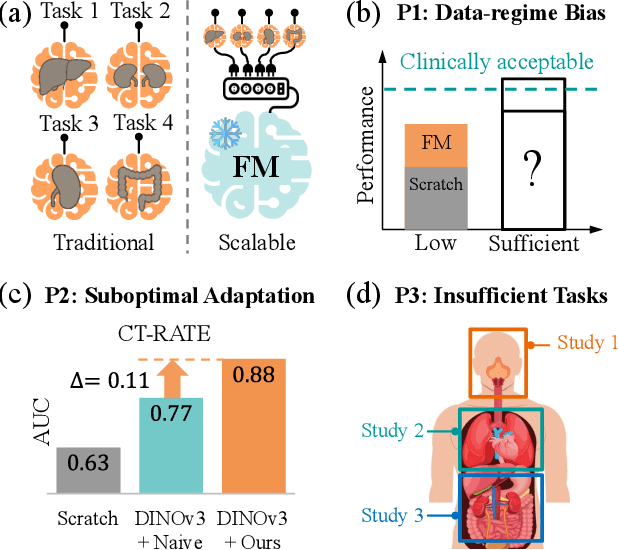
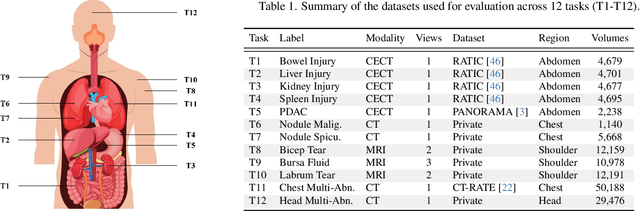

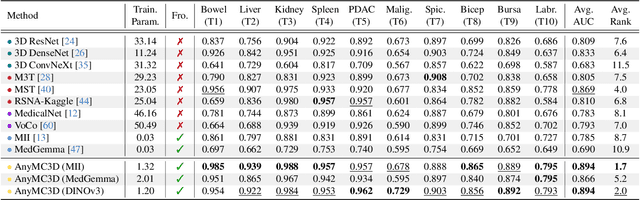
3D medical image classification is essential for modern clinical workflows. Medical foundation models (FMs) have emerged as a promising approach for scaling to new tasks, yet current research suffers from three critical pitfalls: data-regime bias, suboptimal adaptation, and insufficient task coverage. In this paper, we address these pitfalls and introduce AnyMC3D, a scalable 3D classifier adapted from 2D FMs. Our method scales efficiently to new tasks by adding only lightweight plugins (about 1M parameters per task) on top of a single frozen backbone. This versatile framework also supports multi-view inputs, auxiliary pixel-level supervision, and interpretable heatmap generation. We establish a comprehensive benchmark of 12 tasks covering diverse pathologies, anatomies, and modalities, and systematically analyze state-of-the-art 3D classification techniques. Our analysis reveals key insights: (1) effective adaptation is essential to unlock FM potential, (2) general-purpose FMs can match medical-specific FMs if properly adapted, and (3) 2D-based methods surpass 3D architectures for 3D classification. For the first time, we demonstrate the feasibility of achieving state-of-the-art performance across diverse applications using a single scalable framework (including 1st place in the VLM3D challenge), eliminating the need for separate task-specific models.
Autoformalizer with Tool Feedback
Oct 08, 2025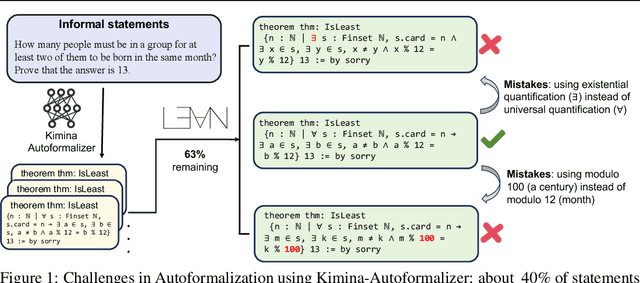
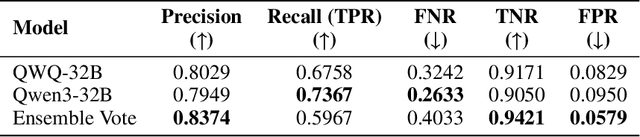
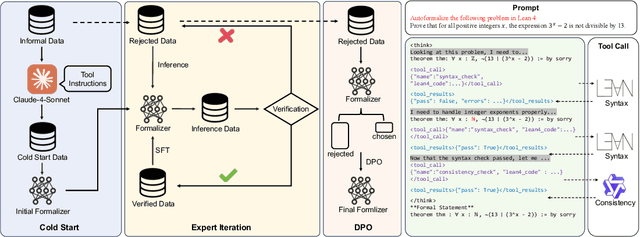
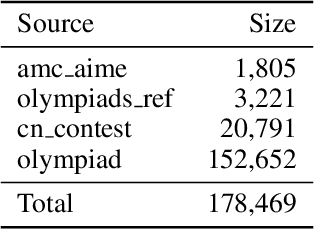
Autoformalization addresses the scarcity of data for Automated Theorem Proving (ATP) by translating mathematical problems from natural language into formal statements. Efforts in recent work shift from directly prompting large language models to training an end-to-end formalizer model from scratch, achieving remarkable advancements. However, existing formalizer still struggles to consistently generate valid statements that meet syntactic validity and semantic consistency. To address this issue, we propose the Autoformalizer with Tool Feedback (ATF), a novel approach that incorporates syntactic and consistency information as tools into the formalization process. By integrating Lean 4 compilers for syntax corrections and employing a multi-LLMs-as-judge approach for consistency validation, the model is able to adaptively refine generated statements according to the tool feedback, enhancing both syntactic validity and semantic consistency. The training of ATF involves a cold-start phase on synthetic tool-calling data, an expert iteration phase to improve formalization capabilities, and Direct Preference Optimization to alleviate ineffective revisions. Experimental results show that ATF markedly outperforms a range of baseline formalizer models, with its superior performance further validated by human evaluations. Subsequent analysis reveals that ATF demonstrates excellent inference scaling properties. Moreover, we open-source Numina-ATF, a dataset containing 750K synthetic formal statements to facilitate advancements in autoformalization and ATP research.